
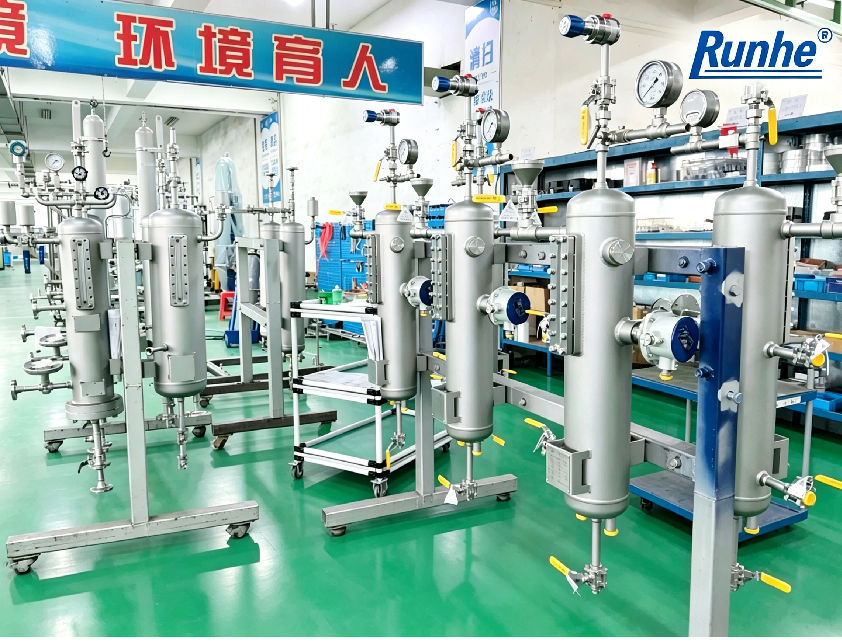
A Plan 52 buffer vessel, also referred to as a seal tank or equalizing tank, is a non-pressurized auxiliary system that supplies buffer fluid to the outboard seal of a tandem double mechanical seal.
Core principle: The buffer fluid pressure inside the vessel is maintained lower than the process medium pressure in the pump seal chamber.
The vessel is connected to a vent or waste gas recovery system and operates at atmospheric pressure without nitrogen pressurization.
This differs from Plan 53, where the barrier fluid is fully pressurized above the process medium pressure.
How a Plan 52 Buffer Vessel Works
The system relies on a pumping ring built into the mechanical seal to create continuous thermosiphon circulation:
1. The pumping ring drives buffer fluid out through the LBO port into the outboard seal chamber for lubrication and cooling.
2. After absorbing frictional heat, the warmer buffer fluid returns to the vessel through the LBI port by density difference.
3. An internal water cooling coil removes heat to sustain stable circulation.
4. The top vent nozzle connects to a flare or waste gas collection system; no nitrogen pressurization is applied.
Key Functions
- Lubricates and cools the outboard mechanical seal and removes operating friction heat.
- Monitors inboard seal condition: When the inboard seal is intact, vessel level and pressure stay stable. If the primary seal leaks, high-pressure process medium enters the vessel, raising level and pressure and triggering high-level / high-pressure alarms.
- Containment: Prevents direct atmospheric release of toxic, flammable and volatile process fluids.
Vessel Construction and Configuration
- Vessel body: 304 or 316 stainless steel, common capacities 12 L and 20 L, with an internal water cooling coil.
- Nozzles: LBO outlet, LBI return, vent port (to off-gas recovery — must stay open), fill port, and drain port.
- Standard instrumentation: Sight-glass level gauge with high/low alarms, pressure gauge with high-pressure alarm, and thermometer.
Installation Requirements
- Mount the vessel 0.3–1.2 m above the mechanical seal for reliable thermosiphon circulation.
- Route both circulation lines continuously upward with minimal elbows to avoid gas pockets.
- Keep the vent line unobstructed; blockage causes vessel overpressure and system failure.
Applications
Plan 52 buffer vessels are widely used with centrifugal pumps handling toxic, flammable, volatile and hazardous media in the oil & gas, petrochemical and chemical industries, where atmospheric leakage is prohibited.
Caution
Plan 52 is not suitable for media with high solid-particle content, as particles can cause severe wear on seal faces.
#API682Plan52buffervessel#tandemmechanicalseal#bufferfluid#thermosiphoncirculation#sealleakagemonitoring


 export@rhseal.com


