
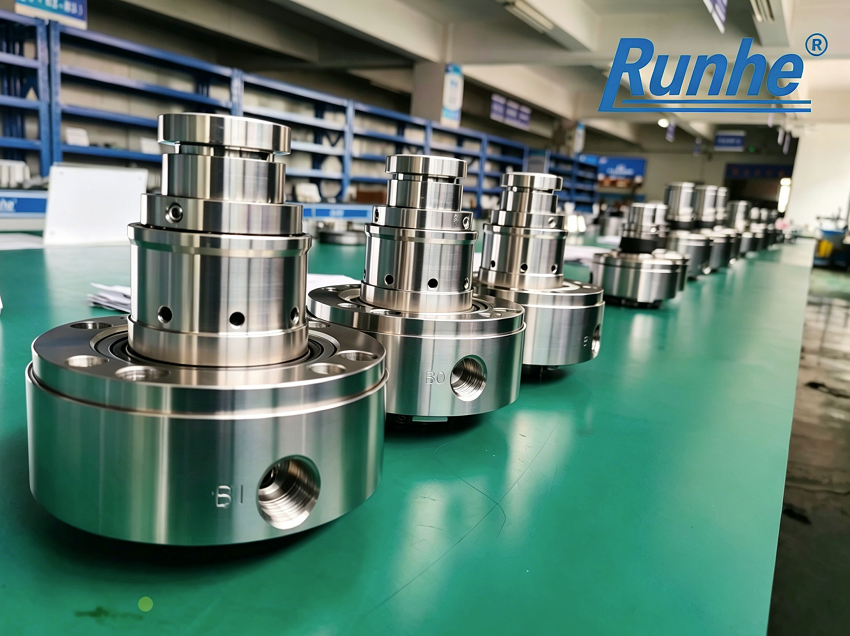
Differences between Internally Mounted and Externally Mounted Seals
A mechanical seal with the stationary ring mounted on the inner side of the gland is referred to as an internally mounted mechanical seal.
A mechanical seal with the stationary ring mounted on the outer side of the gland is referred to as an externally mounted mechanical seal.
A mechanical seal with springs placed inside the sealing fluid is an internally spring-loaded mechanical seal.
A mechanical seal with springs placed outside the sealing fluid is an externally spring-loaded mechanical seal.
For internally mounted (internally spring-loaded) mechanical seals, the springs and rotating rings are installed in the seal chamber and in contact with the medium. The medium pressure
inside the seal chamber can assist sealing.
Advantages: The leakage direction is opposite to the direction of centrifugal force, resulting in favorable stress conditions and low leakage volume. The seals enjoy good cooling and
lubrication conditions and have a wide range of applicable working conditions.
For externally mounted (externally spring-loaded) mechanical seals, the springs and rotating rings are installed outside the seal chamber and do not come into contact with the medium.
They are suitable for media that are highly corrosive, high-viscosity and prone to crystallization.
Since the leakage direction is consistent with the direction of centrifugal force, these seals have a larger leakage volume and are only applicable under low working pressure.
#InternallyMountedMechanicalSeal# ExternallyMountedMechanicalSeal # Spring-LoadedSeal #PumpMechanicalSeal #LowLeakageSeal # CrystallizingMediumSeal


 export@rhseal.com


